Phonics Classes — Build Strong Readers from Day One
Every confident reader begins with phonics. G-Champ's structured phonics program teaches children aged 3 to 8 the essential connection between letters and sounds, giving them the tools to read any English word independently, pronounce clearly, and develop a lifelong love of reading.
What Is Phonics and Why Does It Matter?
Phonics is a method of teaching reading that focuses on the relationship between letters and the sounds they represent. Instead of memorizing entire words by sight, children who learn phonics understand that the letter "b" makes the /b/ sound, "a" makes the /a/ sound, and "t" makes the /t/ sound. Put them together, and the child can read "bat" — even if they have never seen the word before.
This is the fundamental difference between phonics-based instruction and the whole-language approach used in many Indian schools. With whole-language teaching, children recognize words as complete visual shapes. This works for the first few hundred words, but the moment a child encounters an unfamiliar word, they are stuck. With phonics, children possess a decoding system that works for virtually any English word — including words they have never encountered.
Research from institutions including the National Reading Panel (USA) and the Rose Report (UK) has conclusively shown that systematic phonics instruction is the most effective approach for teaching children to read. Countries like the United Kingdom, Australia, and Singapore have mandated phonics as the primary method for early reading instruction. In India, the National Education Policy (NEP) 2020 specifically emphasizes foundational literacy and phonics-based reading instruction in the early years.
At G-Champ, our phonics classes bring this research-backed methodology to children across India. Through our network of 1000+ franchise centers in 700+ cities, we make high-quality phonics instruction accessible to every family that values early literacy.
G-Champ's Phonics Methodology
A five-pillar approach that takes children from zero reading ability to independent, fluent readers.
Letter-Sound Recognition
Children learn the 44 phonemes of the English language — the individual sounds that letters and letter combinations produce. Each phoneme is taught through multi-sensory activities: hearing the sound, seeing the letter, tracing its shape, and associating it with a visual cue. This builds an instinctive connection between written symbols and spoken sounds that becomes the bedrock of all future reading.
Blending
Once children know individual sounds, they learn to push those sounds together smoothly to form words. Starting with simple three-letter CVC words (cat, dog, pen), blending progresses to four-letter blends (stop, frog), consonant clusters, and eventually multi-syllable words. Daily blending practice turns hesitant sound-by-sound decoding into fluid, natural reading.
Segmenting
The reverse of blending, segmenting teaches children to break spoken words into their component sounds. When a child hears "ship," they learn to identify the sounds /sh/ /i/ /p/. This skill is critical for spelling — a child who can segment words accurately can write any word they can say, even without having memorized its spelling. Segmenting exercises form the bridge between reading and writing.
Sight Words
Not every English word follows regular phonics rules. Words like "the," "said," "was," and "could" must be recognized on sight. G-Champ integrates the most common 100+ sight words into the phonics curriculum through flashcard games, sentence-building activities, and repeated reading exposure. Children learn these high-frequency words alongside their phonics skills for complete reading ability.
Fluency Building
The final pillar transforms mechanical decoding into expressive, enjoyable reading. Children practice with graded readers — books carefully matched to their current phonics level. They learn to read with appropriate speed, accuracy, and expression. Oral reading sessions, paired reading, and read-aloud activities build the confidence to read in front of a class, a family gathering, or simply for the pleasure of a good story.
Benefits of Phonics Training for Children
Early Reading Ability
Children who learn phonics start reading 1-2 years ahead of peers who rely solely on school instruction. They can read simple storybooks independently by age 5-6, building academic confidence early.
Correct Pronunciation
Phonics teaches the precise sounds of English from the start. Children develop clear, accurate pronunciation — a lasting advantage in academics, public speaking, and future career interviews.
Spelling Improvement
Segmenting skills allow children to sound out words and write them correctly. Phonics-trained children make fewer spelling errors because they understand the logic behind English spelling patterns.
Vocabulary Growth
When children can decode any word, they encounter and absorb new vocabulary naturally through reading. Their vocabulary grows exponentially compared to children who only learn words taught directly in class.
Confidence in English
The ability to pick up any English text and read it without help transforms a child's self-image. They participate actively in class, volunteer to read aloud, and approach English as a strength rather than a struggle.
Cognitive Development
Phonics engages auditory processing, visual recognition, memory, and sequencing skills simultaneously. These cognitive benefits extend beyond reading into mathematics, logical thinking, and overall academic performance.
Two Levels, One Goal: Independent Reading
Our phonics program is structured into two levels to match each child's developmental stage.
Foundation Level
Ages 3 - 5 Years- Introduction to all 26 letter sounds through songs, stories, and play
- Uppercase and lowercase letter recognition and writing
- Beginning blending — three-letter CVC words (cat, sun, pin)
- Rhyming awareness and syllable clapping games
- First 30 sight words (the, is, and, I, a, to, etc.)
- Oral confidence building — speaking in full sentences
- Fine motor skill development through tracing and colouring
Fluency Building Level
Ages 5 - 8 Years- Digraphs (sh, ch, th, wh) and vowel teams (ai, ee, oa, oo)
- Consonant blends (bl, cr, st, tr) and split digraphs (a-e, i-e)
- Multi-syllable word decoding and compound words
- Complete sight word mastery — 100+ high-frequency words
- Graded reader practice — reading full storybooks independently
- Comprehension skills — understanding and retelling stories
- Expressive reading with proper intonation, pace, and punctuation
What Your Child Will Achieve
Phonemes Mastered
Complete command over all English speech sounds
Sight Words Learned
Instant recognition of high-frequency English words
First Words Read
Children begin reading simple CVC words within 3 months
Independent Reading
Full ability to read age-appropriate books on their own
Watch a G-Champ Phonics Student Read
Oral practice is a key part of our phonics program. Watch how our students develop clear pronunciation and confident reading skills.
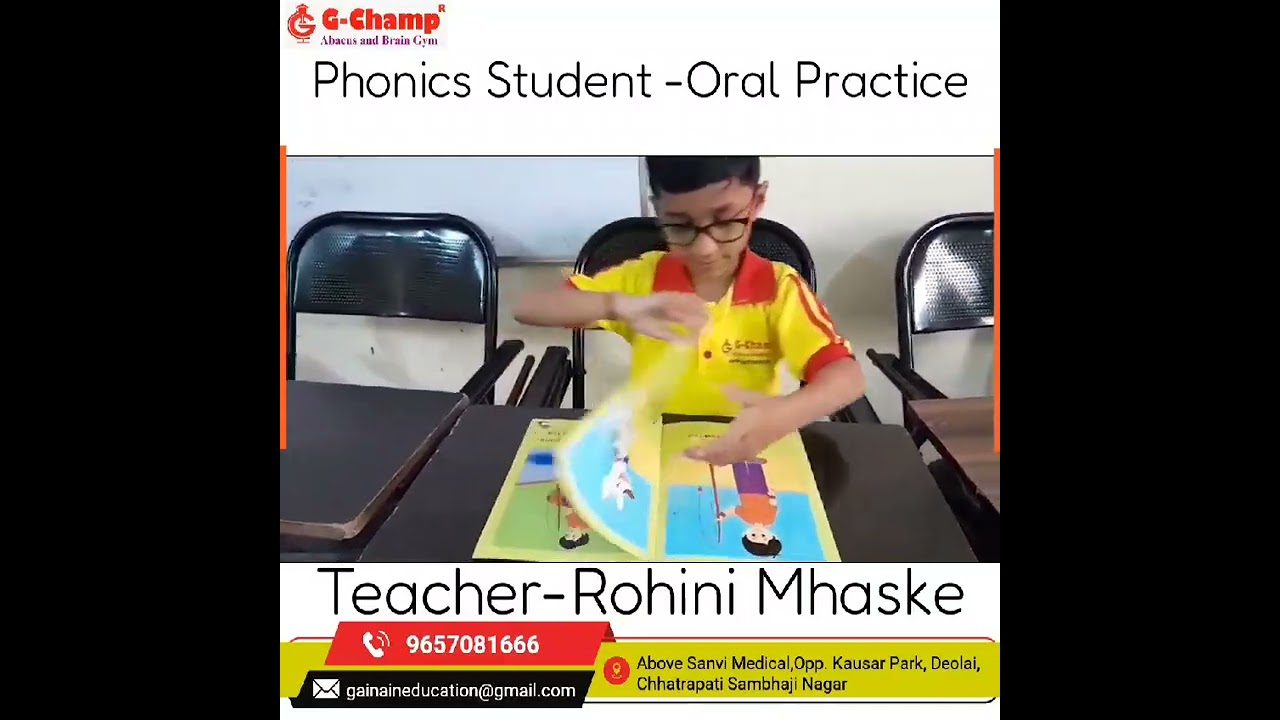
G-Champ Phonics Student — Oral Practice Session
Frequently Asked Questions
Children can begin phonics classes as early as age 3. At G-Champ, we offer a Foundation level for ages 3-5 that introduces letter-sound relationships through songs, stories, and play. The Fluency Building level for ages 5-8 focuses on blending, decoding, and independent reading. Starting early gives children a significant advantage in school readiness.
Most Indian schools teach English using the whole-language or rote memorization approach, where children memorize entire words without understanding letter-sound patterns. G-Champ's phonics program uses systematic synthetic phonics — children first learn individual letter sounds, then learn to blend them into words. This method is backed by research and used in countries like the UK and Australia as the primary reading instruction method.
Yes, pronunciation improvement is one of the core benefits of phonics training. Because children learn the precise sounds that each letter and letter combination makes, they develop clear, accurate English pronunciation from the start. This is especially valuable in India where regional accents can sometimes affect English clarity. Our oral practice sessions specifically target pronunciation refinement.
Most children in our program begin reading simple three-letter (CVC) words within the first 2-3 months. By 6 months, they can read short sentences and simple storybooks. Full independent reading ability — where a child can pick up an age-appropriate book and read it with understanding — typically develops within 8-12 months of consistent phonics training, depending on the child's starting age and regularity of practice.
Absolutely. Phonics is particularly effective for children who are falling behind in reading. Many children struggle because they were taught to memorize words rather than decode them. Once a child learns phonics rules, they gain a toolkit to figure out any unfamiliar word on their own. We have seen children who were labeled "slow readers" in school transform into confident, fluent readers within months of joining our phonics program.
Yes, G-Champ offers a free demo phonics class at all our centers across India. During the demo, your child will participate in a fun, interactive session where they learn a few letter sounds and try blending them into simple words. Parents can observe the teaching methodology and ask questions. To book a free demo, contact us via WhatsApp at +91-7331171987 or visit your nearest G-Champ center.
Related Programs & Resources
Give Your Child the Gift of Reading
Join thousands of parents who chose G-Champ's phonics program to build strong readers. Book a free demo class today or explore franchise opportunities to bring phonics education to your city.