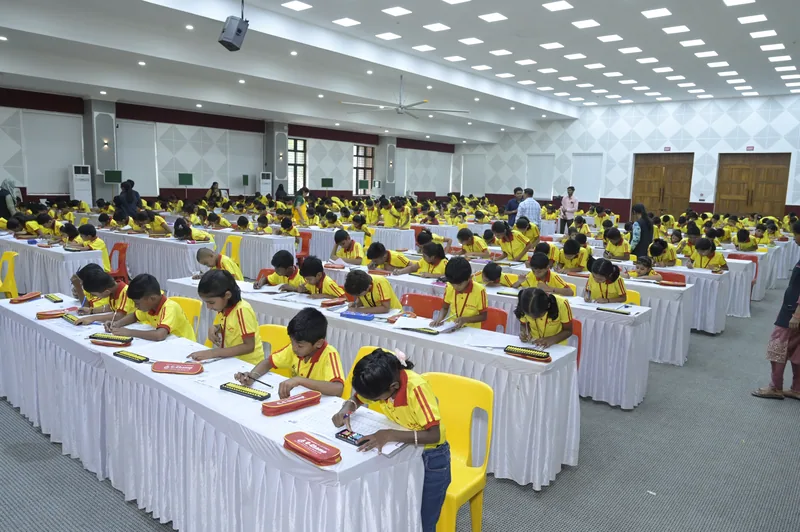
How Abacus Training Improves Concentration in Children
Concentration is the single most important skill that determines a child's academic success. Without the ability to focus, even the brightest students struggle to absorb lessons, complete assignments, and perform well in exams. Yet in today's fast-paced digital world, building and maintaining concentration in children has become one of the greatest challenges parents and educators face. Abacus training offers a proven, structured, and scientifically backed solution to this growing problem, and at G-Champ Abacus & Brain Gym, we have witnessed its transformative power in over 200,000 students across India.
The Concentration Crisis Among Modern Children
If you have noticed that your child cannot sit still for more than a few minutes, you are not alone. Teachers across India report that students today have significantly shorter attention spans compared to a decade ago. The reasons are not surprising: smartphones, tablets, short-form video content, instant-gratification gaming, and social media have rewired how young brains process information.
Research from the National Institute of Mental Health and Neurosciences (NIMHANS), Bangalore, suggests that excessive screen time in children aged 5-12 can reduce sustained attention ability by as much as 30%. A 2024 study published in the Indian Journal of Pediatrics found that children who spend more than two hours daily on screens score significantly lower on concentration tasks than their peers who engage in structured, hands-on learning activities.
The problem compounds as children grow older. Poor concentration in early years leads to weak foundational skills in mathematics and reading, which cascades into poor performance in secondary school and competitive examinations. The question every parent must ask is: what activities can genuinely rebuild and strengthen my child's ability to focus?
How Abacus Training Demands and Builds Deep Focus
Unlike passive learning methods where a child simply reads or watches, abacus training is an intensely active process that demands complete mental engagement. Here is what happens during a typical abacus session at a G-Champ center:
- Bead manipulation: The child physically moves beads on the abacus using precise finger movements. This tactile engagement activates the sensory-motor cortex and requires focused hand-eye coordination.
- Listening to numbers: A teacher or audio recording dictates numbers at a steady pace. The child must listen carefully, interpret each number, and immediately translate it into bead movements. There is no room for distraction.
- Mental visualization: As students advance through G-Champ's 8 progressive levels, they gradually move from physical bead manipulation to mental abacus (anzan). They visualize the abacus in their mind and perform calculations without touching a physical tool. This mental visualization demands extraordinarily deep concentration.
- Speed and accuracy pressure: Timed exercises push students to maintain focus under pressure. Solving 100 addition or subtraction problems in 7 minutes leaves no space for a wandering mind.
This combination of physical action, auditory processing, and mental imagery creates what neuroscientists call "flow state" engagement. The child's entire brain is occupied with a single task, and with daily repetition, this focused state becomes a trainable habit.
The Science: How Abacus Activates Both Brain Hemispheres
One of the most compelling reasons abacus training improves concentration is its unique ability to engage both hemispheres of the brain simultaneously. Most school activities are left-brain dominant: they emphasize language, logic, and sequential thinking. The right hemisphere, responsible for spatial awareness, creativity, and visualization, often remains underutilized.
Abacus training changes this. A landmark study published in the journal Neuroscience Letters used functional MRI (fMRI) to examine the brains of abacus-trained children during mental calculations. The results showed significantly higher activation in both the left prefrontal cortex (responsible for logical processing) and the right parietal cortex (responsible for spatial visualization) compared to children who used conventional arithmetic methods.
This bilateral brain activation has a direct impact on concentration. When both hemispheres work together, the brain creates stronger, more efficient neural pathways. The child's overall cognitive capacity increases, making it easier to sustain attention not just during math, but across all subjects and activities.
Key Research Findings on Abacus and Concentration
- Children trained in abacus show 20-30% improvement in sustained attention tests after 6 months of regular practice.
- Mental abacus (anzan) practitioners demonstrate superior working memory capacity, which is directly linked to concentration ability.
- Abacus-trained students show reduced "mind-wandering" activity in brain scans compared to non-trained peers.
- The tactile nature of bead manipulation activates the cerebellum, which plays a role in attention regulation.
Visual and Auditory Concentration Development
Abacus training uniquely develops both visual and auditory concentration, two skills that are critical for academic success but rarely trained together.
Visual Concentration
During physical abacus work, children must track bead positions across multiple columns, each representing a different place value (units, tens, hundreds, thousands). This requires sustained visual attention and spatial tracking. As students progress to mental abacus, they hold a vivid mental image of the abacus while manipulating virtual beads in their mind's eye. This mental visualization ability directly strengthens the visual attention networks in the brain.
Auditory Concentration
Dictation exercises, where numbers are called out aloud, train the auditory processing system. Children must hear a number, decode it instantly, and perform the corresponding operation. Missing even one number in a sequence of 20 means an incorrect answer. This trains the child's auditory attention to a level that most other activities simply cannot match. Teachers frequently report that abacus-trained students are significantly better listeners in regular classroom settings.
Real Results: What G-Champ Parents and Teachers Report
The science is clear, but nothing speaks louder than real outcomes. Across G-Champ's 1200+ franchise centers in 700+ cities, parents and teachers consistently report measurable improvements in children's concentration within the first 3 to 6 months of training:
- Improved homework focus: Children who previously needed 2 hours for homework start finishing in 45-60 minutes because they can concentrate without constant breaks.
- Better classroom behavior: Teachers notice that abacus-trained students pay attention during lessons, follow instructions more accurately, and participate more actively.
- Higher exam scores: Concentration translates directly to exam performance. Students make fewer careless errors because they can maintain focus through an entire paper.
- Longer reading sessions: Parents report their children voluntarily reading for longer periods, a direct indicator of improved sustained attention.
- Reduced screen dependence: Children who find mental math engaging often show reduced interest in mindless screen time because their brain is receiving stimulation from a more rewarding source.
"My daughter used to fidget through every homework session. After 4 months of abacus classes at G-Champ, she sits down and finishes everything on her own. Her teacher says she is one of the most focused students in class now." — Parent from Chhatrapati Sambhajinagar
Abacus vs Other Concentration-Building Activities
Parents often wonder how abacus training compares to other activities known for building focus. Here is an honest comparison:
Chess: Excellent for strategic thinking and patience, but it develops concentration primarily through visual and logical channels. It does not develop auditory concentration or fine motor coordination the way abacus does. Chess also has a steeper learning curve that can discourage younger children.
Meditation and mindfulness: Scientifically proven to improve focus in adults, but extremely difficult for children aged 5-10 to practice consistently. Young children find sitting still and focusing on breath boring and frustrating. Abacus achieves similar neurological benefits through active, engaging practice that children actually enjoy.
Music lessons: Learning an instrument develops auditory processing and fine motor skills, which is similar to abacus in some respects. However, music lessons do not build mathematical reasoning or mental visualization to the same degree. Abacus and music are complementary, and children who do both often show the highest concentration gains.
Sports and physical activity: Physical activity improves overall brain health and can indirectly support concentration. However, it does not train the specific sustained mental focus required for academic tasks. Abacus training builds the precise type of concentration that transfers directly to classroom performance.
The unique advantage of abacus training is that it simultaneously develops motor coordination, auditory processing, visual tracking, mental visualization, and mathematical skill, all while building deep concentration. No other single activity offers this breadth of cognitive training.
G-Champ's Structured Approach: 8 Levels of Progressive Concentration Building
At G-Champ, our ISO 9001:2015 certified abacus program is designed with concentration development as a core outcome. The 8 progressive levels systematically increase complexity, ensuring that the child's concentration grows steadily without overwhelm:
- Levels 1-2 (Foundation): Children learn basic bead manipulation with single-digit numbers. Focus duration: 5-10 minutes of sustained practice. The emphasis is on building correct finger technique and basic listening skills.
- Levels 3-4 (Development): Multi-digit calculations are introduced. Speed gradually increases. Children begin short mental abacus exercises. Focus duration extends to 15-20 minutes of sustained practice.
- Levels 5-6 (Proficiency): Complex operations including multiplication and division on the abacus. Mental abacus becomes a major component. Students tackle 50-80 problems in timed sessions, requiring 20-30 minutes of unbroken concentration.
- Levels 7-8 (Mastery): Advanced mental abacus with large numbers. Students solve 100 sums in 7 minutes or less. Competition-level speed and accuracy require elite-level sustained concentration of 30+ minutes. At this stage, the concentration skills are deeply embedded and transfer effortlessly to all academic and life activities.
This gradual progression is critical. Throwing a child into 30-minute concentration tasks from day one would cause frustration and resistance. G-Champ's level-by-level approach ensures every child experiences success and builds confidence alongside their growing focus ability.
Tips for Parents: Supporting Concentration Development at Home
While abacus classes provide structured concentration training, parents can amplify results with these daily habits:
- Create a distraction-free practice zone: Designate a quiet spot for abacus practice at home. No TV, no phone, no siblings playing nearby. Even 15 minutes of focused practice in a quiet environment is more valuable than 30 minutes with distractions.
- Set a consistent daily practice time: Children thrive on routine. Whether it is 6 PM or 8 AM, pick a time and stick to it. The brain learns to enter "focus mode" at that time each day.
- Limit screen time before practice: Screens stimulate the brain's reward centers in ways that make sustained focus difficult immediately afterward. Avoid letting your child watch videos or play games for at least 30 minutes before abacus practice.
- Celebrate small milestones: When your child completes a set of problems faster or with fewer errors, acknowledge it. Positive reinforcement strengthens the neural pathways associated with focused effort.
- Practice dictation at home: Read numbers aloud for your child to calculate on the abacus. This builds auditory concentration and makes practice feel like a fun game rather than homework.
- Be patient with the process: Concentration is a skill that builds gradually. Do not expect instant results. Trust the process, stay consistent, and the improvements will come.
For a deeper exploration of the full range of cognitive benefits, read our detailed guide on 10 benefits of abacus training for children's brain development.
The Right Time to Start Is Now
Every week that passes without structured concentration training is a week where your child falls further behind their focused peers. The neural plasticity that makes abacus training so effective is highest between ages 5 and 12. Starting early gives your child the greatest advantage, but even older children benefit significantly. Learn more about the best age to start abacus classes for your child.
G-Champ Abacus & Brain Gym has been building focused, confident, mathematically strong children since 2015. With 1200+ centers across 700+ cities in India and 200,000+ students trained, our program delivers consistent, measurable results in concentration, mental math, and overall academic performance.
Frequently Asked Questions
Abacus training improves concentration by requiring children to simultaneously manipulate beads, listen to numbers being called out, and perform mental calculations. This multi-sensory engagement forces the brain to maintain sustained focus. Over time, regular practice strengthens neural pathways associated with attention, making it easier for children to concentrate in all areas of learning.
Children can begin abacus training as early as age 5, when their fine motor skills and basic number recognition are developing. Starting between ages 5 and 8 is considered ideal because the brain is highly neuroplastic during this period, meaning concentration skills developed through abacus practice become deeply embedded and long-lasting.
Most parents and teachers notice visible improvements in concentration within 3 to 6 months of regular abacus practice. Children typically show better focus during homework, longer attention spans in class, and improved listening skills. At G-Champ, our structured 8-level program ensures steady, measurable progress at every stage.
Both abacus training and meditation improve focus, but they work differently. Meditation teaches stillness and mindfulness, which can be difficult for young children to sustain. Abacus training builds concentration through active, hands-on engagement that children find enjoyable. For most children aged 5-14, abacus training is more practical and effective because it combines focus-building with academic skill development.
While abacus training is not a medical treatment for ADHD, many parents report that the structured, hands-on nature of abacus practice helps children with mild attention difficulties. The tactile bead manipulation provides sensory input that keeps restless minds engaged, and the progressive difficulty levels offer achievable goals that build confidence. Always consult a medical professional for diagnosed ADHD, but abacus training can be a beneficial supplementary activity.
Build Your Child's Concentration with G-Champ
Join 200,000+ students across India who have transformed their focus and academic performance through abacus training.