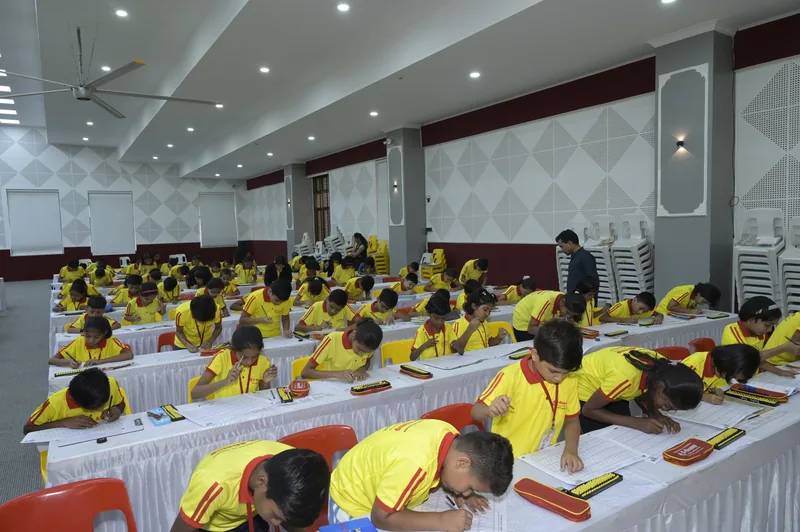
The benefits of abacus training go far beyond learning how to calculate numbers quickly. For over a decade, researchers in child development and education have demonstrated that abacus-based mental arithmetic fundamentally rewires how a child's brain processes information, solves problems, and retains knowledge. At G-Champ Abacus & Brain Gym, we have witnessed these transformations firsthand in more than 200,000 students across 1200+ centers in India.
If you are a parent wondering whether abacus training is worth investing in for your child, this article lays out ten scientifically backed and practically observed benefits that make abacus one of the most effective brain development tools available today. Whether your child is 5 or 14, these advantages can shape their academic journey and build cognitive skills that last a lifetime.
1 Improved Concentration and Focus
One of the earliest and most visible benefits of abacus training is a dramatic improvement in a child's ability to concentrate. In an age of short attention spans driven by smartphones and social media, the abacus demands something increasingly rare from children: sustained, undivided attention.
During abacus practice, a child must focus on the movement of beads, listen to numbers being called out, visualize bead positions in their mind, and arrive at the correct answer — all within seconds. This multi-layered engagement trains the brain to filter distractions and maintain focus for longer periods. Parents regularly report that their children complete homework faster, listen more attentively in class, and show fewer signs of restlessness after just a few months of training.
At G-Champ, our structured 8-level curriculum progressively increases the complexity of calculations, ensuring that a child's concentration capacity grows steadily with each level. Want to learn more about this specific benefit? Read our detailed guide on how abacus training improves concentration in children.
2 Enhanced Memory — Photographic and Visual Recall
Abacus training develops a unique type of memory that most traditional education methods overlook: visual or photographic memory. As students advance through the levels, they transition from physically moving beads on the abacus to performing calculations entirely in their mind by visualizing an imaginary abacus.
This process of mental visualization creates powerful neural pathways associated with visual recall. Children who train on the abacus can remember sequences of numbers, complex patterns, and multi-step instructions with far greater accuracy than their peers. Research published in the journal Neuroscience Letters has shown that abacus-trained children demonstrate enhanced activity in the brain regions responsible for visuospatial working memory.
The practical impact is immediate. Students recall formulas more easily, remember what was taught in class, and perform better in examinations that require memorization — whether in mathematics, science, or even languages. At G-Champ, our ISO 9001:2015 certified training methodology is specifically designed to strengthen this visual memory through progressive mental arithmetic exercises across all 8 levels.
3 Better Listening Skills
A benefit that often surprises parents is how significantly abacus training improves a child's listening ability. In a typical abacus classroom, numbers are called out rapidly by the instructor, and students must process these auditory inputs in real time while simultaneously manipulating beads or visualizing them mentally.
This constant practice of listening, processing, and responding builds active listening skills that transfer directly into the classroom. Children become better at following multi-step instructions from teachers, understanding verbal explanations, and participating in discussions. They learn to process spoken information quickly and accurately — a skill that becomes increasingly valuable as academic complexity rises through higher grades.
In G-Champ's training sessions, the speed of number dictation increases with each level, ensuring that listening acuity develops alongside calculation speed. By the advanced levels, students are processing dictated numbers at speeds that would challenge most adults.
4 Faster Mental Calculation — 100 Sums in 7 Minutes
Perhaps the most impressive and immediately measurable benefit of abacus training is the astonishing speed at which children learn to perform mental calculations. G-Champ students regularly demonstrate the ability to solve 100 addition and subtraction sums in under 7 minutes — without a calculator, without pen and paper, and without the abacus itself.
This speed is not a trick or shortcut. It is the result of systematic training that transforms the abacus from a physical tool into a mental one. Students literally see the abacus in their mind and move imaginary beads at incredible speed to arrive at answers. This process, known as mental abacus or anzan, engages both hemispheres of the brain and produces calculation speeds that far surpass what traditional math education achieves.
G-Champ Fact: In national and state-level abacus competitions, G-Champ students consistently rank among the top performers. Our training methodology covers addition, subtraction, multiplication, and division across 8 progressively challenging levels — from single-digit operations to multi-digit mental arithmetic involving thousands.
Curious about how mental math compares to calculator dependency? Read our comparison of abacus vs calculator and why mental math still matters.
5 Boosted Confidence in Mathematics
Math anxiety is one of the most widespread problems among school-age children in India and globally. Many children develop a fear of numbers as early as primary school, and this fear compounds over the years, leading to poor performance, avoidance, and a limiting belief that they are simply "not a math person."
Abacus training systematically dismantles this anxiety. When a child who once struggled with basic addition discovers they can mentally calculate multi-digit problems faster than their classmates — and faster than a calculator-dependent adult — the effect on their confidence is transformative. They stop fearing math. They start enjoying it.
This confidence extends far beyond the abacus classroom. Students carry it into their school math exams, into science classes where calculations are required, and eventually into competitive exam preparation. Parents at G-Champ centers frequently share that their child's overall attitude toward academics shifted once abacus training removed the barrier of math anxiety. The knowledge that they possess a skill most others do not gives them a quiet, enduring sense of self-assurance.
6 Whole Brain Development — Left and Right Brain Activation
Traditional schooling in India and most countries is heavily left-brain oriented. Reading, writing, grammar, arithmetic, logical reasoning — these activities primarily engage the left hemisphere. The right hemisphere, which handles creativity, spatial awareness, imagination, and holistic thinking, gets comparatively little stimulation in a conventional classroom.
Abacus training is one of the few educational activities that simultaneously activates both hemispheres of the brain. Here is how it works:
- Left brain engagement: Processing numbers, performing sequential calculations, applying logical rules for bead movements, and arriving at precise answers.
- Right brain engagement: Visualizing the abacus mentally, imagining bead positions in three-dimensional space, recalling visual patterns, and performing creative problem-solving when faced with complex calculations.
This dual activation is what neuroscientists refer to as "whole brain development." Functional MRI studies have confirmed that abacus-trained individuals show significantly higher bilateral brain activation compared to non-trained individuals when performing arithmetic tasks. The result is a more balanced, more capable brain — one that excels not only in mathematics but in any discipline that requires a blend of logic and creativity.
G-Champ's program is built specifically to maximize this bilateral activation. Our 8-level abacus training curriculum transitions students from physical bead manipulation (primarily left-brain) to fully mental calculations (requiring intense right-brain visualization), ensuring comprehensive whole brain development.
7 Improved Problem-Solving Skills
Abacus training teaches children far more than arithmetic. At its core, the abacus is a problem-solving tool. Every calculation presents a small puzzle: given a set of numbers, find the most efficient path to the answer using the rules of bead manipulation. As problems grow more complex through the 8 levels, children develop increasingly sophisticated strategies for breaking down large problems into manageable steps.
This problem-decomposition approach — the ability to take a complex challenge, identify its components, and tackle each systematically — is one of the most valuable cognitive skills a child can develop. It applies to mathematical word problems, science experiments, coding challenges, and even real-life situations like planning a project or resolving a conflict.
Children trained on the abacus develop a natural instinct for analytical thinking. They learn to approach unfamiliar problems with curiosity rather than anxiety, break them into smaller pieces, test approaches mentally, and arrive at solutions with confidence. These are exactly the problem-solving skills that India's National Education Policy (NEP 2020) aims to foster in students.
8 Better Academic Performance Across All Subjects
One of the most significant findings from long-term studies of abacus-trained children is that the benefits are not limited to mathematics. Children who undergo sustained abacus training show measurable improvement in academic performance across all subjects, including science, language, and even social studies.
How is this possible? The answer lies in the foundational cognitive skills that abacus training strengthens:
- Concentration: Helps in every subject — from reading comprehension to laboratory observations.
- Memory: Aids in memorizing vocabulary, historical dates, scientific formulas, and grammatical rules.
- Listening skills: Improves understanding of lectures and verbal instructions across all classes.
- Speed and accuracy: Enables faster completion of tests and assignments in every subject.
- Confidence: Reduces overall academic anxiety, not just math anxiety.
At G-Champ, we hear from parents across our 1200+ centers that the impact of abacus training ripples through their child's entire report card. The student who joined to improve at math ends up excelling in science, reading more attentively, and scoring higher overall. It is this holistic academic improvement that makes abacus training one of the highest-return educational investments a parent can make.
9 Preparation for Competitive Exams — JEE, NEET, and Olympiads
India's competitive exam landscape is among the most demanding in the world. Whether it is JEE for engineering, NEET for medicine, or national and international Math Olympiads, these examinations test not just knowledge but speed, accuracy, and the ability to perform under intense pressure. Abacus-trained students enter this arena with a significant advantage.
The benefits translate directly into competitive exam performance:
- Speed: Mental calculation ability means less time spent on arithmetic in quantitative sections, leaving more time for complex problem-solving.
- Accuracy: Reduced calculation errors mean fewer marks lost to careless mistakes — a critical factor when exam toppers are separated by fractions of a percent.
- Time management: Students who can process numbers mentally spend less time on each question, allowing strategic allocation of time to harder problems.
- Stress management: The discipline developed through years of abacus practice translates into better composure during high-pressure exams.
- Logical reasoning: Enhanced problem-solving abilities directly aid in the analytical sections of competitive examinations.
Many G-Champ alumni have gone on to crack JEE, NEET, and various Olympiad-level examinations, attributing their quantitative edge to the mental math foundation built during their abacus training years. Starting early — ideally between ages 5 and 8 — gives children the maximum time to develop these skills before they face the competitive exam stage.
10 Life Skills: Speed, Accuracy, and Discipline
The final and perhaps most enduring benefit of abacus training is the set of life skills it instills. Beyond the classroom, beyond exams, beyond academics entirely, abacus training teaches children three qualities that define success in any field: speed, accuracy, and discipline.
Speed — not reckless haste, but efficient processing. Abacus-trained children learn to think fast, respond quickly, and work efficiently. In a world that increasingly rewards those who can process information rapidly, this is an invaluable skill.
Accuracy — the habit of getting things right the first time. Abacus training is unforgiving of errors; a single wrong bead movement cascades into an incorrect answer. This trains children to be precise, to double-check their work, and to develop an internal quality standard that carries into every task they undertake.
Discipline — the commitment to daily practice, to mastering one level before advancing to the next, to showing up even when progress feels slow. The 8-level structure of G-Champ's program teaches children that mastery is a journey, not an event. They learn patience, persistence, and the satisfaction of earned achievement.
These are not just academic skills. They are the foundation of a successful career, productive habits, and a growth-oriented mindset. Parents who enroll their children in abacus training are investing not just in better math scores but in character traits that will serve their child for life.
Why G-Champ for Abacus Training?
G-Champ Abacus & Brain Gym has been at the forefront of brain development education since 2015. Our ISO 9001:2015 certified program is trusted by over 200,000 students across 1200+ franchise centers in 700+ cities and 9+ states across India. Here is what sets our abacus training apart:
- Structured 8-level curriculum that progresses from physical abacus to full mental arithmetic
- ISO 9001:2015 certified training methodology ensuring consistent quality across all centers
- Trained and certified instructors at every center who follow our proven teaching framework
- Regular competitions at center, city, state, and national levels to motivate and benchmark progress
- Comprehensive program covering addition, subtraction, multiplication, and division
- Online practice tools for continued learning at home between sessions
Every benefit described in this article is not theoretical — it is something we have observed, measured, and celebrated across our network of 200,000+ students over the past decade. If you are ready to give your child the cognitive advantage that abacus training provides, book a free trial class at your nearest G-Champ center today.
Frequently Asked Questions
The main benefits of abacus training include improved concentration, enhanced photographic memory, faster mental calculation ability, whole brain development (both left and right hemispheres), boosted confidence in mathematics, better listening skills, stronger problem-solving abilities, improved academic performance across all subjects, preparation for competitive exams, and development of life skills like speed, accuracy, and discipline.
The ideal age to start abacus training is between 5 and 14 years. Children in this age range have developing neural pathways that respond exceptionally well to abacus techniques. G-Champ's 8-level program is designed to progressively build skills starting from basic bead manipulation to advanced mental arithmetic, making it suitable for beginners of any age within this range.
Abacus training activates both hemispheres of the brain simultaneously. The left brain handles logical computation and sequential processing, while the right brain engages through visualization of bead movements and spatial reasoning. This dual activation strengthens neural connections, improves synaptic efficiency, and promotes whole brain development — something traditional math education alone cannot achieve.
Yes, abacus training provides a strong foundation for competitive exams like JEE, NEET, and Math Olympiads. Students who train on the abacus develop lightning-fast calculation speed, reduced error rates, better time management during exams, and superior logical reasoning skills. These advantages directly translate into higher scores in the quantitative sections of competitive examinations.
Most parents notice visible improvements within the first 3 to 6 months of consistent abacus training. Early improvements include better concentration, faster homework completion, and increased confidence with numbers. G-Champ's structured 8-level curriculum ensures progressive skill development, with students typically completing 100 addition and subtraction sums in under 7 minutes by the intermediate levels.
Give Your Child the Abacus Advantage
Join 200,000+ students across 1200+ G-Champ centers. Book a free trial class and watch your child's potential unfold.