Abacus vs Calculator: Which Trains the Brain Better?
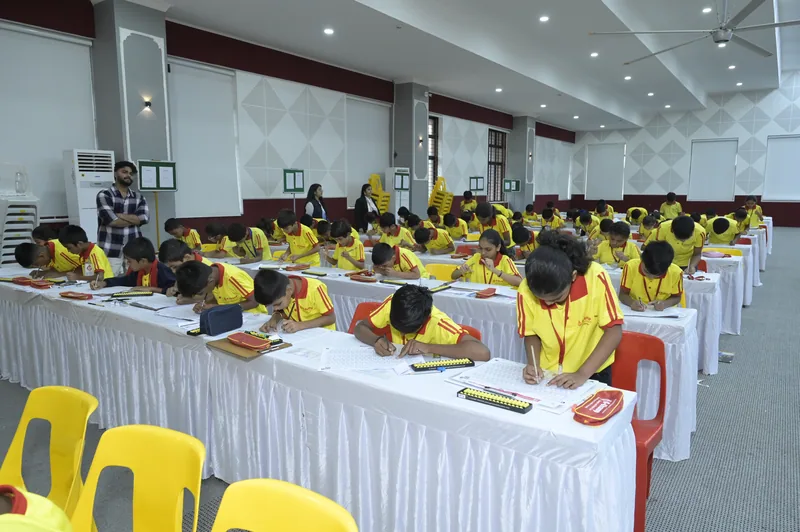
Abacus trains the brain better than a calculator. An abacus builds mental math, visualization, memory and concentration because the child does the calculation — mentally picturing and moving the beads. A calculator only delivers the answer, so the brain does no arithmetic work and those skills never develop. For long-term cognitive growth, the abacus wins; for a one-off quick sum, the calculator is faster.
The debate between abacus and calculator has intensified in recent years, especially among Indian parents navigating a world that seems increasingly digital. Smartphones have calculators built in, AI can solve complex equations, and even primary school children carry smartwatches. So why should your child spend months learning to move beads on a wooden frame when a calculator delivers instant answers?
The answer lies in a fundamental difference that most parents overlook: a calculator gives you answers, but an abacus gives you understanding. And in an era where machines can compute faster than any human, the ability to think mathematically — to visualize numbers, estimate quantities, and reason logically — has become more valuable than ever before.
At G-Champ Abacus & Brain Gym, we have trained over 200,000 students across 1200+ centers in India, and the transformation we witness is always the same: children who once feared numbers begin solving 100 arithmetic problems in just 7 minutes — without any device. This article explores why mental math through abacus training remains essential, what happens to the brain when children rely on calculators, and how you can give your child an advantage that no machine can replace.
How Abacus Training Actually Works
To understand the abacus vs calculator debate, you first need to know what abacus training really involves. It is not simply about moving beads. The abacus is a structured, multi-level program that rewires how children process numbers.
The Physical Stage: Bead Manipulation
In the initial levels, children use a physical abacus — a frame with rods and beads arranged in columns representing units, tens, hundreds, and thousands. They learn to add, subtract, multiply, and divide by moving beads according to specific rules. This physical movement engages the fingers, eyes, and brain simultaneously, creating strong neural pathways between motor skills and mathematical reasoning.
The Transition: Mental Visualization
As students progress through intermediate levels, something remarkable happens. They begin to visualize the abacus in their mind. The physical tool is removed, and children perform calculations by imagining the bead movements. This is called "mental abacus" or "anzan" — a technique where the brain essentially runs a virtual abacus at extraordinary speed.
The Mastery Stage: Speed and Accuracy
At advanced levels, students can mentally process multi-digit addition, subtraction, multiplication, and division in seconds. Their fingers often move involuntarily in the air, mimicking bead movements, as their brain computes at speeds that astonish even experienced educators. This is not a trick — it is the result of systematic neural training across G-Champ's 8 progressive levels.
The Calculator Dependency Problem
Calculators are extraordinary tools for professionals, engineers, and scientists. Nobody disputes their usefulness in complex work. But when young children use calculators as a primary computation method, something concerning happens — they develop what educators call "calculator dependency."
Here is what calculator dependency looks like in practice:
- No number sense: Children cannot estimate whether an answer is reasonable. They type 25 x 4 and accept whatever the screen displays, even if they accidentally pressed the wrong button and got 254.
- Loss of mental flexibility: Without the ability to manipulate numbers mentally, children struggle with word problems, logical reasoning, and multi-step calculations that require intermediate results.
- Weakened working memory: Mental math exercises and strengthens working memory — the brain's ability to hold and manipulate information temporarily. Calculator use bypasses this entirely.
- Exam vulnerability: In competitive exams like Olympiads, scholarship tests, and later JEE or NEET, calculators are not allowed. Students who never developed mental math skills find themselves severely disadvantaged.
- Reduced confidence: A child who cannot verify a simple grocery bill or split a restaurant check without a phone feels fundamentally less confident with numbers.
Brain Development: Abacus vs Calculator — What the Research Shows
The strongest argument in the abacus vs calculator debate comes from neuroscience. Multiple studies using brain imaging technology (fMRI) have revealed dramatic differences in brain activity between abacus-trained children and those who rely on calculators.
Key Research Findings
- Bilateral brain activation: Abacus training activates both the left hemisphere (logical processing) and the right hemisphere (spatial visualization, creativity). Calculator use only engages a narrow band of the left hemisphere responsible for reading and button-pressing.
- Enhanced neural connectivity: A study published in the journal Neural Plasticity found that children with long-term abacus training showed significantly stronger white matter connections between brain regions, indicating more efficient information processing.
- Superior working memory: Research from the University of China demonstrated that abacus-trained children scored 15-20% higher on working memory tests compared to age-matched peers, even on tasks unrelated to mathematics.
- Improved concentration span: A 2019 study in Frontiers in Psychology showed that abacus learners demonstrated measurably longer attention spans and better resistance to distraction during cognitive tasks.
- Lasting structural changes: Brain imaging reveals that the gray matter density in regions associated with spatial reasoning and numerical processing is measurably higher in children who complete abacus training — changes that persist into adulthood.
In simple terms, abacus training literally builds a better brain. A calculator, by contrast, outsources the very cognitive work that develops these neural pathways.
Abacus vs Calculator: A Side-by-Side Comparison
| Factor | Abacus Training | Calculator Use |
|---|---|---|
| Brain hemispheres engaged | Both (left + right) | Left only (partially) |
| Number sense development | Strong — deep understanding | Weak — answer-dependent |
| Working memory | Strengthened significantly | Not exercised |
| Concentration improvement | Measurable improvement | No effect |
| Speed (basic arithmetic) | Faster than calculator (trained) | Instant but dependent |
| Confidence with numbers | High — self-reliant | Low — device-reliant |
| Competitive exam readiness | Excellent preparation | No preparation |
| Creativity and visualization | Enhanced through mental imagery | Not developed |
| Long-term cognitive benefit | Structural brain changes | None documented |
Real-World Skills: Mental Math in Daily Life, Exams, and Interviews
Mental arithmetic is not just a classroom skill — it shows up in countless real-world situations where pulling out a calculator is either impractical or socially awkward:
- Shopping and budgeting: Quickly calculating discounts, comparing unit prices, and staying within a budget while walking through a store.
- Tipping and splitting bills: Computing a fair split at a restaurant or calculating service charges on the spot.
- Time management: Figuring out travel times, scheduling conflicts, and deadline calculations mentally.
- Competitive exams: National and international math Olympiads, scholarship exams, and entrance tests like JEE, NEET, CAT, and banking exams all test mental calculation speed. Students with abacus training benefits consistently outperform their peers.
- Job interviews: Many companies in finance, consulting, and analytics include mental math tests in their interview process to assess quick thinking and numerical aptitude.
- Entrepreneurship: Business owners constantly make quick calculations — margins, costs, percentages, inventory — where mental speed translates directly to better decisions.
G-Champ's Approach: Building Mental Math Champions
At G-Champ Abacus & Brain Gym, our structured abacus training program is designed to transform how children think about numbers. With ISO 9001:2015 certification and a presence across 1200+ centers in 700+ cities, our methodology has been refined through a decade of experience and over 200,000 students.
Here is what makes the G-Champ approach effective:
- 8 progressive levels: From basic bead manipulation to advanced mental arithmetic, each level builds on the previous one with clear milestones and assessments.
- Trained and certified teachers: Every G-Champ instructor completes a rigorous certification program, ensuring consistent quality across all centers nationwide.
- Regular competitions: National and inter-center competitions motivate students to push their limits. Our students regularly solve 100 arithmetic sums in just 7 minutes — a feat that amazes parents and educators alike.
- Holistic brain development: Abacus is just one of 6 programs we offer. Combined with Vedic Maths, Phonics, Handwriting Improvement, KalFun Maths, and Rubik's Cube training, children receive a complete brain development experience.
- Parent engagement: Regular progress reports, demo sessions, and parent workshops ensure families understand and support their child's learning journey.
"My daughter used to count on her fingers in class 3. After 18 months at G-Champ, she won the state-level abacus competition and now solves multiplication problems faster than I can type them into my phone." — Parent from Pune
When Calculators Are Appropriate
This article is not anti-calculator. Calculators and digital computation tools are indispensable in many contexts, and children should absolutely learn to use them at the appropriate stage. The key is timing.
Calculators are perfectly appropriate for:
- Higher mathematics: Trigonometry, calculus, statistics, and engineering calculations in college and beyond.
- Professional work: Accounting, scientific research, data analysis, and any field requiring precision with large or complex numbers.
- Verification: Using a calculator to double-check mental calculations is a healthy practice that combines both skills.
- Complex operations: Square roots, logarithms, and advanced functions that go beyond basic arithmetic.
The ideal progression is clear: build mental math foundations through abacus training between ages 5 and 14, then introduce calculators as an efficiency tool for advanced work. This way, children understand what the calculator is doing and can spot errors, rather than blindly trusting a screen. To find the ideal starting point for your child, read our guide on the best age to start abacus classes.
The Verdict: Abacus Builds Thinkers, Calculators Build Users
The abacus vs calculator question ultimately comes down to what you want for your child. Do you want a child who can use a tool to find answers, or a child who understands numbers so deeply that they become the tool? In a world where artificial intelligence and automation are replacing routine computation, the children who will thrive are those who can think critically, estimate intuitively, and reason mathematically — skills that abacus training delivers and calculator use does not.
Mental math is not an outdated relic of the pre-digital era. It is a cognitive superpower that builds neural pathways, strengthens memory, sharpens concentration, and instills mathematical confidence that lasts a lifetime. The abacus is simply the most effective vehicle for developing that superpower in young minds.
Frequently Asked Questions
Yes, for children aged 5 to 14, abacus training is far superior to calculator use. Abacus develops mental visualization, strengthens number sense, and activates both brain hemispheres. Calculators simply display answers without building any cognitive skills. Once children master mental arithmetic through abacus, they can perform calculations faster than a calculator for everyday math.
Children can start abacus training as early as age 5, and ideally before they develop a dependency on calculators. The ages between 5 and 8 are considered the golden window for abacus learning because the brain is highly plastic and receptive to new neural pathways. Starting early ensures children build strong mental math foundations before calculators are introduced in school.
In many cases, yes. Well-trained abacus students can solve addition, subtraction, multiplication, and division problems mentally in seconds — often faster than someone can type the same problem into a calculator. At G-Champ, students regularly demonstrate solving 100 arithmetic sums in just 7 minutes, which is faster than calculator-assisted solving for those same problems.
Absolutely not. Abacus training does not replace modern tools — it builds a stronger foundation for using them. Children who develop mental math skills through abacus consistently outperform their peers in school mathematics, competitive exams, and problem-solving tasks. The cognitive benefits — improved memory, concentration, and analytical thinking — transfer to every subject, not just math.
Most parents notice visible improvement within 3 to 6 months of regular abacus training. Children typically show faster mental calculations, improved concentration in school, and greater confidence with numbers. At G-Champ, the structured 8-level program ensures progressive skill building, with students achieving basic mental arithmetic by level 3 and advanced speed calculation by level 6 to 8.
Give Your Child the Mental Math Advantage
Join 200,000+ students across 1200+ G-Champ centers. Book a free trial class and watch the transformation begin.