How Abacus Training Helps in Competitive Exam Preparation
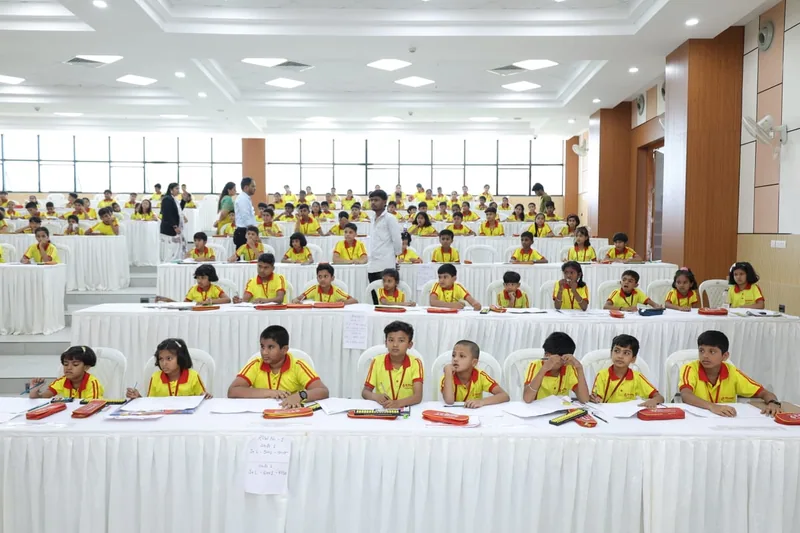
India is a nation that runs on competitive exams. From JEE and NEET for engineering and medical aspirants, to CAT for MBA hopefuls, banking exams for government job seekers, and SSC for central services — millions of students sit for high-stakes tests every year where a single mark can separate selection from rejection. At the heart of nearly every one of these exams lies a common challenge: the quantitative section. And the students who consistently dominate these sections share a surprising secret — many of them trained in abacus during their childhood.
Abacus training and competitive exam success are more connected than most parents realize. The mental math speed, sustained concentration, and numerical confidence that abacus training develops between ages 5 and 14 become powerful cognitive tools when those same students face gruelling 3-hour examinations a decade later. At G-Champ Abacus & Brain Gym, we have trained over 200,000 students across 1200+ centers in India, and the pattern is unmistakable — children who complete our structured abacus program carry a measurable advantage into their academic and competitive exam journeys.
This article explores the precise connection between early abacus training and competitive exam performance, examining how specific skills transfer across years of development to produce exam-ready students who approach quantitative challenges with speed, accuracy, and unshakeable confidence.
The Competitive Exam Landscape in India
To understand why abacus training matters for competitive exams, consider the sheer scale and intensity of India's examination ecosystem:
- JEE Main and Advanced: Over 12 lakh students compete annually for roughly 16,000 seats in IITs. Physics and Chemistry numericals demand rapid mental calculations. Every saved second counts.
- NEET: More than 20 lakh students attempt this medical entrance exam each year. Biology aside, the Physics and Chemistry sections are laden with numerical problems requiring speed and precision.
- CAT: The gateway to IIMs and top MBA colleges tests quantitative aptitude with problems designed to be solved in under 2 minutes each. Mental math speed is not optional — it is essential.
- Banking exams (IBPS, SBI PO, RBI): Number series, simplification, data interpretation, and percentage calculations form the backbone of these papers. Candidates have roughly 30 seconds per question.
- SSC CGL and CHSL: Quantitative aptitude sections test arithmetic speed under extreme time pressure, with thousands competing for limited government positions.
- Olympiads (IMO, SOF, ASSET): These international and national competitions test mathematical reasoning and problem-solving at advanced levels, often without calculators.
Across all of these exams, one truth remains constant: the quantitative sections are not just about knowing the formulas — they are about applying them fast enough to finish within the time limit while maintaining accuracy under pressure.
The Math Problem: Why Most Students Struggle with Quantitative Sections
Every year, lakhs of students who understand mathematical concepts perfectly well still underperform in competitive exams. The reason is rarely a lack of knowledge — it is a lack of computational speed and mental stamina. Here is what typically goes wrong:
- Slow calculations: Students spend 30-60 seconds on arithmetic that should take 5-10 seconds, leaving insufficient time for the harder problems that carry more marks.
- Rough work overload: Pages of rough calculations create confusion, lead to transcription errors, and slow down the problem-solving process.
- Careless mistakes under pressure: When time is running out, rushed calculations produce wrong answers — even when the approach was correct.
- Mental fatigue: Sustaining sharp focus for 3 hours of continuous problem-solving exhausts students who have not trained their concentration capacity.
- Math anxiety: Students who lack confidence with numbers experience stress that further degrades their calculation speed and decision-making ability.
Abacus training directly addresses every single one of these problems — not as a quick fix, but as a deep, neurological rewiring that builds exam-ready capabilities from the ground up.
How Abacus Training Builds Exam-Ready Skills
The connection between abacus training and competitive exam excellence is not theoretical — it is grounded in specific cognitive skills that transfer directly from the abacus classroom to the examination hall.
Speed: Mental Calculations in Seconds
The most obvious advantage is raw computational speed. Students who complete G-Champ's 8-level abacus program can perform multi-digit addition, subtraction, multiplication, and division entirely in their heads — no rough work needed. At our national competitions, students routinely solve 100 arithmetic sums in just 7 minutes. This speed translates directly into competitive exams: when a JEE aspirant can mentally compute intermediate calculations in a physics numerical, they save 20-30 seconds per question. Across a 90-question paper, that adds up to 30-45 minutes of saved time — enough to attempt an additional 15-20 questions.
Accuracy: Trained to Get Right Answers Consistently
Speed without accuracy is worse than being slow — it produces wrong answers faster. Abacus training uniquely develops both together. The visualization technique used in mental abacus (anzan) creates a systematic process where errors are naturally caught because the mental bead positions must balance correctly. G-Champ students develop an intuitive sense for whether an answer "feels right," a skill that helps them instantly spot calculation errors during exams.
Concentration: Sustained Focus During 3-Hour Exams
Competitive exams like JEE, NEET, and CAT demand 3 hours of continuous, intense cognitive effort. Most students experience significant mental fatigue by the second hour, leading to careless mistakes and poor time management in the final section. Abacus training is fundamentally a concentration exercise — students must hold multiple numbers in their working memory, track bead positions, and maintain accuracy across extended problem sets. This regular practice of sustained attention physically strengthens the prefrontal cortex, building a concentration capacity that serves students through even the longest examinations.
Memory: Remembering Formulas, Tables, and Intermediate Results
Working memory — the ability to hold and manipulate information temporarily — is the cognitive skill most heavily tested in competitive exams. Students must remember formulas, hold intermediate calculation results, compare answer choices, and track their position within multi-step problems. Abacus training exercises working memory more intensely than almost any other childhood activity. Research published in Neural Plasticity demonstrates that abacus-trained children show 15-20% stronger working memory performance compared to age-matched peers.
Confidence: No Math Anxiety, Comfortable with Numbers
Perhaps the most underrated advantage is psychological. Students who grew up training with an abacus develop a fundamentally different relationship with numbers. Where other students feel anxiety when faced with complex calculations, abacus-trained students feel at home. This confidence eliminates the performance-degrading stress that affects millions of exam candidates. A calm, confident student makes better strategic decisions — choosing which questions to attempt, when to skip ahead, and when to trust their mental calculation rather than wasting time on rough work.
Specific Exam Connections: Where Abacus Skills Shine
The cognitive advantages of abacus training manifest differently across various competitive exams. Here is how they apply to India's most important tests:
JEE and NEET: Quick Calculations in Physics and Chemistry Numericals
JEE Physics and Chemistry are numerical-heavy sections where students must compute values involving multiplication of decimal numbers, unit conversions, and algebraic substitutions. A typical JEE Physics problem might require computing the product of charge, velocity, and magnetic field values — all multi-digit decimals. Abacus-trained students handle these intermediate calculations mentally, maintaining their focus on the problem's logic rather than getting bogged down in arithmetic. In NEET Chemistry, calculating molecular weights, molarity, and stoichiometric ratios becomes significantly faster with mental math proficiency.
CAT and MBA Entrance: Quantitative Aptitude Section Dominance
The CAT quantitative aptitude section is specifically designed to test mathematical agility. Problems in number theory, algebra, geometry, and arithmetic must be solved in approximately 2 minutes each. The difference between a 90th percentile score and a 99th percentile score often comes down to speed — students who can mentally simplify fractions, compute percentages, and evaluate expressions without paper have an enormous advantage. Abacus training builds exactly this kind of numerical fluency.
Banking Exams: Number Series, Simplification, and Data Interpretation
Banking exams are perhaps where abacus training provides the most direct advantage. The simplification section literally tests mental arithmetic — can you compute 5678 + 3421 - 2345 x 2 / 5 in 30 seconds? For abacus-trained candidates, this is trivially easy. Number series problems, which require identifying patterns in sequences, become more intuitive when you can rapidly compute differences and ratios between terms. Data interpretation problems that involve calculating percentages from tables and charts are similarly accelerated by mental math proficiency.
Olympiads: Advanced Problem-Solving with Speed
Mathematical Olympiads test deep problem-solving ability, but speed still matters — students must navigate through complex multi-step proofs and calculations within a fixed time frame. The enhanced working memory, pattern recognition, and numerical intuition developed through abacus training allow Olympiad participants to explore solution paths more quickly, test hypotheses mentally, and arrive at elegant solutions while competitors are still working through basic arithmetic steps.
The Earlier, the Better: Starting Abacus at Age 5-7 for Exams at Age 15-18
One of the most common questions parents ask is whether abacus training is worth starting if competitive exams are still a decade away. The answer is an emphatic yes — and in fact, the earlier the better. Here is why the timeline works:
The 10-Year Advantage Timeline
- Ages 5-7 (Start abacus): The brain is in its most plastic phase. Neural pathways for mathematical thinking form rapidly and permanently. Children learn to visualize numbers and develop foundational speed.
- Ages 8-10 (Intermediate levels): Mental abacus skills solidify. Children begin performing complex calculations without the physical tool. Working memory expands significantly.
- Ages 11-12 (Advanced levels): Speed and accuracy reach near-automatic levels. Mathematical confidence is deeply established. The child is now inherently "good at math."
- Ages 13-14 (Completion): Abacus training concludes. The cognitive benefits — speed, memory, concentration, confidence — are permanently embedded in the brain's neural architecture.
- Ages 15-18 (Competitive exams): While peers struggle with basic calculations during JEE or NEET preparation, the abacus-trained student processes numericals effortlessly, freeing cognitive resources for higher-order problem-solving and exam strategy.
The key insight is that abacus training does not teach exam content — it builds the cognitive machinery that makes learning exam content faster and more effective. A student with strong mental math foundations will absorb JEE coaching material in half the time it takes a student who still struggles with basic calculations.
Research Supporting Early Math Training and Later Exam Performance
The connection between early mathematical training and later academic performance is well-documented in educational research:
- A longitudinal study published in Developmental Psychology tracked students over 12 years and found that children who received structured mental math training before age 8 scored significantly higher on standardized math tests at age 16, even after controlling for socioeconomic factors and school quality.
- Research from the University of Chicago demonstrated that early number sense training predicts mathematical achievement in secondary school more strongly than any other single factor, including IQ scores.
- A 2022 meta-analysis in Educational Research Review covering 45 studies confirmed that abacus training produces lasting improvements in arithmetic fluency, working memory, and spatial reasoning — all skills directly tested in competitive examinations.
- Brain imaging studies show that the neural pathways strengthened by childhood abacus training remain active and efficient into adulthood, suggesting that the cognitive benefits are not temporary but structural and permanent.
The science is clear: early investment in mental math training through abacus produces compounding returns that peak precisely when students need them most — during their competitive exam years.
G-Champ Students and Competitive Exams: Success Indicators
At G-Champ Abacus & Brain Gym, we have observed consistent patterns among students who completed our program and went on to attempt competitive exams:
- Faster problem completion: G-Champ alumni consistently report finishing quantitative sections 15-20 minutes before the allotted time, allowing them to review answers and attempt additional questions.
- Higher accuracy rates: The mental checking habits developed during abacus training reduce careless errors — the single largest source of mark loss in competitive exams.
- Better time management: Students who can gauge calculation time accurately make smarter decisions about which questions to attempt and which to skip, optimizing their overall score.
- Reduced exam anxiety: Numerical confidence built over years of abacus practice translates into a calm, focused exam temperament that many candidates lack.
- Olympiad success: G-Champ students regularly participate and excel in national and international abacus competitions, and many go on to perform well in Science and Math Olympiads.
"I started abacus at G-Champ when I was 6 years old. By the time I was preparing for JEE, mental calculations were second nature. While my coaching class friends struggled with numerical computations, I could do them in my head and focus on understanding the physics concepts. That advantage was invaluable." — G-Champ alumnus, IIT aspirant
Combining Abacus with Vedic Maths for Maximum Exam Advantage
While abacus training builds foundational mental math speed and cognitive capacity, combining it with Vedic Mathematics creates a particularly powerful combination for competitive exam preparation. Here is how the two programs complement each other:
| Skill Area | Abacus Contribution | Vedic Maths Contribution |
|---|---|---|
| Basic arithmetic speed | Mental visualization of calculations | Shortcut formulas for quick computation |
| Multiplication | Mental multi-digit multiplication | Nikhilam and Urdhva-Tiryagbhyam sutras |
| Squares and cubes | Computed through mental bead work | Instant squares using Vedic patterns |
| Division | Mental long division capability | Paravartya sutra for rapid division |
| Checking answers | Mental recalculation speed | Digit sum verification method |
| Algebra and equations | Strong number manipulation base | Sunyam Samyasamuccaye and other sutras |
Students who train in both abacus and Vedic Mathematics with its 16 sutras develop two complementary calculation systems. The abacus provides the mental visualization engine, while Vedic Maths provides elegant shortcuts and alternative methods. In a competitive exam, this dual capability means students can choose the fastest approach for each problem — mental abacus for straightforward arithmetic, Vedic shortcuts for specific patterns like squaring numbers near 100 or multiplying numbers near a base.
G-Champ offers both programs, and many of our most successful students complete the abacus program first (ages 5-12) and then add Vedic Mathematics (ages 10-14), creating a comprehensive mental math toolkit that serves them through every examination they will ever face.
Practical Steps: How to Start Building Your Child's Exam Advantage Today
If your child is between 5 and 12 years old, the window for building a lasting competitive exam advantage through abacus training is open right now. Here is a practical roadmap:
- Enroll in a structured abacus program: Look for ISO-certified training with a proven track record. G-Champ's 8-level program is designed for progressive skill building with regular assessments and competitions.
- Commit to consistent practice: Like any skill, mental math improves with regular practice. Encourage daily practice sessions of 15-20 minutes alongside weekly classes.
- Participate in competitions: National and inter-center abacus competitions build performance under pressure — exactly the skill needed for competitive exams.
- Add Vedic Mathematics at the right time: Once your child has completed intermediate abacus levels, introduce Vedic Maths to add shortcut techniques to their mental calculation arsenal.
- Track cognitive development: Notice improvements beyond math — better concentration in school, improved memory retention, and growing confidence with numbers are all signs that the training is building lasting neural advantages.
The students who will dominate competitive exams in 2030 and beyond are the ones whose parents made the decision to invest in their cognitive development today. Abacus training is not just about beads and numbers — it is about building brains that are ready for any challenge.
To understand the full range of benefits that abacus training offers children, including cognitive, academic, and personal development gains, explore our detailed guide.
Frequently Asked Questions
Yes, abacus training significantly helps in JEE and NEET preparation. Both exams require fast and accurate calculations in Physics, Chemistry, and Mathematics. Students trained in abacus can perform complex arithmetic mentally — computing molecular weights, solving numerical problems, and handling unit conversions — without reaching for rough paper. This saves crucial minutes in a time-pressured exam where every second counts.
The ideal age to start abacus training is between 5 and 7 years. Starting early allows children to complete all 8 levels of abacus training well before they encounter competitive exams at age 15 to 18. The mental math skills, concentration, and number confidence built during childhood become deeply ingrained neural patterns that activate automatically during high-pressure exam situations.
Absolutely. Banking exams like IBPS, SBI PO, and SSC CGL feature heavy quantitative aptitude sections with number series, simplification, percentages, profit-loss, and data interpretation. These sections test raw calculation speed under strict time limits. Abacus-trained candidates can solve simplification and number series problems mentally in seconds, giving them a significant advantage over candidates who rely on written calculations.
Abacus training requires sustained mental focus — students must visualize bead positions, track intermediate results, and maintain accuracy across dozens of problems in sequence. This regular practice of concentrated attention physically strengthens the prefrontal cortex, the brain region responsible for focus and impulse control. As a result, abacus-trained students can maintain sharp concentration throughout 3-hour exams like JEE, NEET, or CAT without the mental fatigue that affects untrained students.
Abacus training is not a replacement for subject-specific exam coaching — it is a foundational advantage that makes all other preparation more effective. Think of it as building a powerful engine before entering a race. Abacus gives students speed, accuracy, concentration, and confidence with numbers. They still need to learn exam-specific concepts, strategies, and practice with past papers. However, students with abacus foundations consistently learn faster and score higher in quantitative sections compared to peers without this training.
Build Your Child's Competitive Exam Advantage Today
Join 200,000+ students across 1200+ G-Champ centers. Start building the mental math foundation that leads to exam success.