What is Vedic Mathematics? 16 Sutras Explained Simply
Vedic Mathematics is one of India's most remarkable gifts to the world of learning. Rooted in the ancient Vedic scriptures, this extraordinary system of mathematics offers 16 powerful sutras (formulas) that can transform the way students approach numbers. Whether your child is struggling with basic multiplication or an adult is preparing for competitive exams like JEE, NEET, or CAT, Vedic Maths provides shortcuts and mental techniques that make calculations faster, simpler, and even enjoyable. In this comprehensive guide, we will explore what Vedic Mathematics really is, its fascinating history, all 16 sutras with simple examples, and how mastering these techniques gives students an undeniable advantage in academics and beyond.
The Fascinating History of Vedic Mathematics
The story of Vedic Mathematics begins with Jagadguru Shankaracharya Bharati Krishna Tirtha Ji Maharaj (1884-1960), a brilliant scholar who served as the Shankaracharya (head monk) of the Govardhan Math in Puri, Odisha. Between 1911 and 1918, Tirtha Ji spent years studying the Parishishta (appendix) of the Atharva Veda, one of the four primary Vedas of Hindu scripture.
During his deep meditation and scholarly research, he rediscovered 16 mathematical sutras (formulas) and 13 sub-sutras (corollaries) hidden within these ancient texts. He realized that these concise Sanskrit aphorisms contained the keys to solving virtually any mathematical problem — from basic arithmetic to advanced calculus — using remarkably simple and elegant methods.
Tirtha Ji wrote a comprehensive book titled "Vedic Mathematics", which was published posthumously in 1965, five years after his passing. The book immediately captured the attention of mathematicians, educators, and students worldwide. What made it revolutionary was not merely the speed of calculation it offered, but the underlying logic that made mathematics intuitive rather than mechanical.
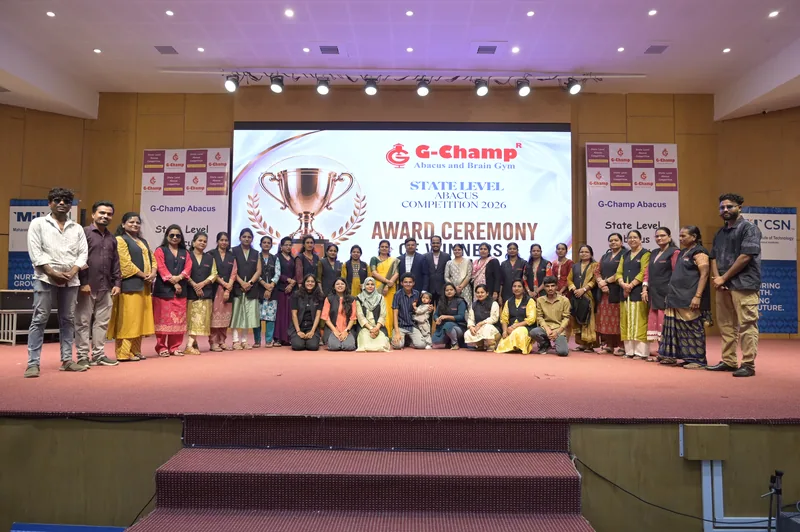
Today, Vedic Mathematics is taught in thousands of educational institutions across India and abroad. Organizations like G-Champ Abacus & Brain Gym have brought structured Vedic Maths programs to over 1200+ centers across India, making these ancient techniques accessible to students in 700+ cities.
Why Vedic Maths Matters Today
In an era of calculators and smartphones, you might wonder why anyone would need mental math shortcuts. The answer lies in what Vedic Mathematics develops beyond just calculation speed:
- Mental agility: Students who practice Vedic Maths develop sharper thinking and faster decision-making abilities.
- Exam advantage: Competitive exams like JEE, NEET, CAT, CLAT, and banking exams impose strict time limits. Vedic techniques can reduce calculation time by 50-80%.
- Confidence with numbers: Many students develop math anxiety because conventional methods feel tedious. Vedic Maths makes numbers approachable and fun.
- Brain development: Regular practice strengthens neural pathways related to logical reasoning, pattern recognition, and spatial awareness.
- Foundation for higher studies: The conceptual understanding Vedic Maths builds makes advanced topics in algebra, calculus, and geometry easier to grasp.
The 16 Sutras of Vedic Mathematics
Each of the 16 sutras is a short Sanskrit phrase that encapsulates a mathematical principle. Below, we explain every sutra with its meaning and a practical application so you can see just how powerful these ancient formulas are.
Sutra 1: Ekadhikena Purvena
This sutra is incredibly useful for squaring numbers ending in 5 and for certain types of division. The idea is beautifully simple: take the digit(s) before the last one and multiply by "one more than itself," then append 25.
Step 1: Take the digit before 5, which is 7.
Step 2: Multiply 7 by (7+1) = 7 x 8 = 56
Step 3: Append 25 to the result: 5625
Example: 115 x 115 = ?
Step 1: Take 11 (digits before 5).
Step 2: 11 x 12 = 132
Step 3: Append 25: 13225
Sutra 2: Nikhilam Navatashcaramam Dashatah
This powerful sutra helps with multiplication of numbers close to a base (10, 100, 1000, etc.). You find the deficit of each number from the base, then use a simple cross-subtraction and multiplication pattern.
97 is 3 less than 100 (deficit = -3)
93 is 7 less than 100 (deficit = -7)
Left part: 97 - 7 = 90 (or 93 - 3 = 90)
Right part: (-3) x (-7) = 21
Answer: 9021
Sutra 3: Urdhva-Tiryagbyham
This is perhaps the most versatile sutra in Vedic Mathematics. It provides a general method for multiplication of any two numbers using a vertical-and-crosswise pattern. Once mastered, you can multiply any two numbers mentally.
Step 1 (vertical right): 3 x 4 = 12, write 2 carry 1
Step 2 (crosswise): (2x4) + (3x1) = 8 + 3 = 11, +1 carry = 12, write 2 carry 1
Step 3 (vertical left): 2 x 1 = 2, +1 carry = 3
Answer: 322
Sutra 4: Paraavartya Yojayet
This sutra simplifies division problems, particularly when the divisor is slightly greater than a power of 10 (like 12, 103, 1004). Instead of performing long division, you transpose the divisor's digits and use them as multipliers.
Divisor 112 is close to 100. Transpose last two digits: -1, -2
Using these as operating digits, perform the adjusted division
to get the quotient and remainder quickly.
Sutra 5: Shunyam Saamyasamuccaye
This sutra is used for solving certain types of equations. If the sum of the numerators is equal to the sum of the denominators (or if a common factor appears on both sides), the equation resolves to zero. It is especially useful in simplifying algebraic expressions and solving equations where terms cancel out symmetrically.
Sutra 6: Anurupye Shunyamanyat
This sutra applies to simultaneous equations. When one set of coefficients is in a proportional ratio, the other variable can be immediately determined as zero or solved directly. It dramatically shortens the process of solving systems of linear equations.
Sutra 7: Sankalana-Vyavakalanabhyam
This sutra provides a technique for solving simultaneous equations by adding or subtracting them to eliminate one variable. While this concept is taught in conventional algebra, the Vedic approach makes the selection of which operation to use intuitive and immediate.
3x + 2y = 18
3x - 2y = 6
Adding both: 6x = 24, so x = 4
Subtracting: 4y = 12, so y = 3
Solution: x = 4, y = 3 (solved in seconds!)
Sutra 8: Puranapuranabhyam
This sutra helps solve problems by completing a number to the nearest convenient base. It is particularly useful for simplifying additions, subtractions, and certain algebraic expressions. The idea is to round a number up to a convenient whole, perform the operation, and then adjust.
Complete 598 to 600 (add 2)
600 + 246 = 846
Subtract the 2 you added: 846 - 2 = 844
Sutra 9: Chalana-Kalanabyham
This sutra deals with differential calculus, factorization of quadratic expressions, and solving special types of equations. It uses the principle of identifying what changes and what remains constant to simplify the problem. It is one of the more advanced sutras, primarily applied in higher mathematics.
Sutra 10: Yavadunam
This sutra is specifically designed for squaring numbers close to a base (10, 100, 1000). You calculate the deficiency from the base, adjust the number accordingly, and append the square of the deficiency.
Deficiency from 100: 4
Left part: 96 - 4 = 92
Right part: 4 x 4 = 16
Answer: 9216
Example: 103 squared (base 100)
Surplus: 3
Left part: 103 + 3 = 106
Right part: 3 x 3 = 09
Answer: 10609
Sutra 11: Vyashtisamanshtih
This sutra leverages the relationship between individual parts and their total. It is used to solve problems where you can break a complex calculation into simpler component parts, solve each part independently, and combine the results. It is especially useful in simplifying complex fractions and algebraic expressions.
Sutra 12: Shesanyankena Charamena
This sutra provides a method for expressing fractions as decimals using the last digit of the denominator. It is particularly effective for converting vulgar fractions into their decimal equivalents quickly, and for finding recurring decimal patterns without performing long division.
Using the last digit (7) and its complement with 10,
you can generate the recurring decimal 0.142857...
through a simple multiplication chain instead of long division.
Sutra 13: Sopaantyadvayamantyam
This sutra is applied to specific types of algebraic equations, particularly those involving fractions with consecutive numbers in the denominator. It provides a direct formula for finding the answer without cross-multiplication or lengthy algebraic manipulation.
Sutra 14: Ekanyunena Purvena
This sutra is the complement of the first sutra and is used for multiplication where one number consists entirely of 9s (like 99, 999, 9999). It provides an instant multiplication method.
Step 1: Left part = 88 - 1 = 87
Step 2: Right part = 99 - 87 = 12 (complement)
Answer: 8712
Example: 456 x 999 = ?
Left part: 456 - 1 = 455
Right part: 999 - 455 = 544
Answer: 455544
Sutra 15: Gunitasamuchyah
This sutra is used to verify the correctness of multiplication and factorization results. It states that the product of the sum of the digits of factors should equal the sum of the digits of the product. It serves as an elegant check mechanism — similar to the concept of casting out nines, but more versatile.
Sutra 16: Gunakasamuchyah
The final sutra is the converse of Sutra 15. It is used for verification of division and factorization problems. When you factorize a polynomial or perform division, this sutra provides a quick check to confirm the result is correct without redoing the entire computation.
Practical Examples: Vedic Maths in Action
Let us put several sutras together to see how Vedic Mathematics handles real-world calculations that students encounter in exams:
Multiplication of Numbers Near 100
88 deficit: -12 | 97 deficit: -3
Left part: 88 - 3 = 85 (cross-subtract)
Right part: 12 x 3 = 36
Answer: 8536
Verify: 88 x 97 = 8536 (Correct!)
Squaring Numbers Quickly
85 squared: 8 x 9 = 72, append 25 = 7225
105 squared: 10 x 11 = 110, append 25 = 11025
995 squared: 99 x 100 = 9900, append 25 = 990025
Multiplying by 11 Instantly
Write the digits with a gap: 7 _ 2
Fill the gap with the sum: 7 + 2 = 9
Answer: 792
86 x 11 = ?
8 _ 6 | Gap sum: 8 + 6 = 14
Write 4, carry 1: (8+1)46
Answer: 946
How Vedic Maths Helps in Competitive Exams
Every year, millions of Indian students appear for competitive examinations where speed in calculation is not a luxury — it is a necessity. Here is how Vedic Mathematics gives students a measurable advantage:
- JEE Main & Advanced: Physics and Chemistry numerical problems often require quick arithmetic. Students who know Vedic shortcuts can save 15-20 minutes per paper, which is substantial in a 3-hour exam.
- NEET: The physics section involves heavy calculations. Vedic Maths helps students verify answers quickly using digit-sum checks (Sutra 15).
- CAT / MBA Entrance: The Quantitative Aptitude section is designed to test speed. Vedic techniques for percentage calculation, ratio solving, and multiplication give a direct advantage.
- Banking Exams (IBPS, SBI PO): The Data Interpretation section requires rapid calculations with large numbers — exactly where Vedic Maths shines.
- SSC CGL / CHSL: With 25 questions in 20 minutes in the math section, students need to solve each question in under 50 seconds. Vedic shortcuts make this achievable.
- Olympiads: Mathematical olympiads test creative problem-solving. The pattern-recognition skills developed through Vedic Maths help students approach unfamiliar problems with confidence.
A study conducted among students preparing for banking exams found that those trained in Vedic Mathematics scored 30-40% higher in quantitative sections compared to their peers who relied solely on conventional methods. The improvement came not just from speed, but from the confidence that comes with having multiple approaches to any problem. Read more about how mental math training helps in competitive exam preparation.
G-Champ's Vedic Maths Program Structure
At G-Champ Abacus & Brain Gym, we have developed a structured Vedic Mathematics curriculum that takes students from absolute beginners to advanced practitioners. Our program is ISO 9001:2015 certified and has been refined through years of teaching over 200,000+ students across India.
Program Highlights
- Age group: 8 years and above (including adults preparing for competitive exams)
- Duration: Progressive levels spanning 12-18 months
- Class format: Interactive sessions with real-time problem solving, not rote memorization
- Practice tools: Worksheets, online practice modules, and periodic assessments
- Competitions: Students participate in inter-center and national-level Vedic Maths competitions
- Certification: Students receive level-completion certificates recognized by the G-Champ network
Our trained instructors do not just teach the sutras — they help students understand when to apply which technique. This application-based approach is what differentiates G-Champ from generic tutorial programs. Visit our Vedic Maths classes page for detailed curriculum information and to book a free trial class.
What Makes G-Champ Different?
- 1200+ centers across 700+ cities in India — a center is likely near you
- ISO 9001:2015 certified training methodology
- Experienced trainers who undergo rigorous certification before teaching
- Integrated approach: Our students often combine Vedic Maths with abacus training for maximum brain development
- Regular competitions that motivate students and build confidence
- Parent progress reports that track improvement over time
Getting Started with Vedic Mathematics
If you or your child want to begin learning Vedic Mathematics, here are some practical steps:
- Build a strong foundation: Ensure basic arithmetic skills (addition, subtraction, multiplication tables up to 20) are solid before starting Vedic Maths.
- Start with the most practical sutras: Begin with Nikhilam (Sutra 2), Urdhva-Tiryagbyham (Sutra 3), and Ekadhikena Purvena (Sutra 1) — these three alone will cover most everyday calculation needs.
- Practice daily: Spend 15-20 minutes each day practicing Vedic techniques. Consistency matters more than long, infrequent sessions.
- Join a structured program: Self-study is good, but a guided program like G-Champ's ensures you learn the correct application of each sutra and get regular feedback.
- Participate in competitions: Competing against other students is the fastest way to improve speed and accuracy under pressure.
"Vedic Mathematics is not just about calculating faster — it is about thinking differently. When a student sees a multiplication problem and instantly recognizes which sutra to apply, they have developed a mathematical instinct that no calculator can replicate." — G-Champ Education Team
Vedic Mathematics stands as a testament to the mathematical genius of ancient India. Whether you are a parent wanting to give your child a competitive edge, a student preparing for entrance exams, or simply someone who wants to make peace with numbers, the 16 sutras of Vedic Maths offer a path that is both intellectually rewarding and practically useful. With over 200,000+ students already benefiting from these techniques at G-Champ centers across India, there has never been a better time to start your Vedic Mathematics journey.
Frequently Asked Questions
Vedic Mathematics is a system of mathematical techniques derived from ancient Indian scriptures (the Vedas). Rediscovered by Bharati Krishna Tirtha Ji Maharaj, it consists of 16 sutras and 13 sub-sutras that simplify arithmetic, algebra, geometry, and calculus, enabling students to solve complex problems mentally at remarkable speed.
There are 16 main sutras (formulas) and 13 sub-sutras (corollaries) in Vedic Mathematics. Together, these 29 techniques cover virtually every area of mathematics, from basic multiplication to advanced calculus and algebraic factorization.
Children can start learning Vedic Maths from age 8-9, once they have a basic understanding of multiplication tables and arithmetic. However, students of any age — including adults preparing for competitive exams — can benefit. G-Champ offers structured programs from age 8 to adult learners.
Absolutely. Vedic Maths is extremely useful for JEE, NEET, CAT, banking exams (IBPS, SBI), SSC, and UPSC. These exams have tight time limits, and Vedic techniques can reduce calculation time by 50-80%, giving students a significant advantage in quantitative sections.
Yes, they are different but complementary. Abacus training uses a physical tool to develop mental visualization and is best started at age 5-6. Vedic Maths uses formulaic shortcuts and is ideal from age 8 onwards. G-Champ offers both programs, and many students benefit from learning both for comprehensive brain development.
You can enroll by visiting your nearest G-Champ center, calling +91-7331171987, or sending a WhatsApp message. With 1200+ centers across 700+ cities, there is likely a center near you. We also offer a free trial class. Visit our contact page to find a center.
Ready to Master Vedic Mathematics?
Join 200,000+ students across India who are building lightning-fast calculation skills with G-Champ.